Search the SPREP Catalogue

Refine Search Results

Related Countries

Language

Available Online

Related Countries

Available Online

57 result(s) found.

Sort by

You searched for

Integrated Climate Change Risks in the Agriculture and Health Sectors in Samoa (ICCRAHSS) - Agriculture Component: Geographical Information Systems Activities

GEF

,

Ministry of Agriculture and Fisheries (Government of Samoa)

,

UNDP

2010
In 1989, the Asian Development Bank provided technical assistance to the then Department of Agriculture and the Survey Department through a NZ Consulting Firm - ANZDEC under an ADB Land Resource Planning Survey Project. The Project provided training on mapping and GIS capability for the survey staff who were involved in the mapping work. Electronic GIS data and equipment were handed over to the Department of Agriculture at the end of the project which were later on damaged by Cyclone Ofa in 1990. A decade later, the Integrated Climate Change Risks in Agriculture and Health Sectors (ICCRAHSS) Project funded by the GEF through UNDP contracted the services of a consultant to provide: -improved GIS maps for soil, crops and rainfall distribution under different climatic projections; -review existing GIS systems and possible areas for collaboration; -consider a program to support capacity building on the use of the system and; -some applications that addresses options for climate change adaptation for the agriculture sector. Based on this report, a GIS system for the Ministry of Agriculture was procured to address the need for such a system to be in place with the expectation that the system will be properly utilized and maintained by relevant people.
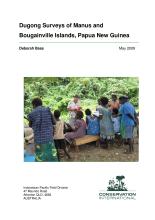
Dugong surveys of Manus and Bougainville Islands, Papua New Guinea
Available Online

Bass Deborah

2009
Dugong dugon are the last extant species in the Family Dugongidae and are listed as Vulnerable to extinction by the IUCN Red List. The dugong population is believed to be in decline globally. Throughout its range, relic populations remain and are separated by large areas where populations have disappeared (Marsh & Lefebvre 1994). The degree of the decline of numbers or fragmentation of its range is not known for any country. For many countries the only information available is from incidental sightings, drownings and anecdotal information. The Pacific region supports the world's largest remaining population of dugongs (Marsh et al. 2002). Dugong occur in most of Melanesia, Papua New Guinea (PNG), the northeast and east coasts of Australia and as far east as Vanuatu.. The current status of dugongs is unknown throughout the region (Marsh et al. 2002) and information on dugong distribution and abundance is outdated or non-existent. It is likely that dugongs are widely distributed in small numbers in much of PNG. the Solomon Islands and Vanuatu and that larger numbers occur in the Papua New Guinea waters of Torres Strait. Marsh et al. (2002) states that their reliance on relatively shallow water seagrass beds for food, limits the ability of dugongs to travel between islands and continents that are separated by extensive areas of deep water. For this reason, many island populations become essentially isolated, making these populations especially vulnerable to extinction.