Search the SPREP Catalogue

Refine Search Results

Language

Available Online

Available Online

88 result(s) found.

Sort by

You searched for

  • Author Asian Development Bank
    X
Costs and bene? ts for biodiversity following rat and cat eradication on Te Hauturu-o-Toi/Little Barrier Island
Biodiversity Conservation, BRB
Available Online

Bell, E.

,

Campbell, J.

,

Cassey, P.

,

Ewen, J.G.

,

Green, C.

,

Gri?ths, R.

,

Joyce, L.

,

Rayner, M.

,

Towns, D.

,

Toy, R.

,

Veitch, C.R.

,

Wade, L.

,

Walle, R.

2019
Considerable bene?ts can be achieved for indigenous biodiversity when invasive vertebrates are removed from islands. In New Zealand, two logistically challenging eradications were undertaken, one to remove cats (Felis catus) and the other Paci?c rats (Rattus exulans) from Te Hauturu-o-Toi/Little Barrier Island (Hauturu). Here we document the short- and long-term impacts of these interventions on the biodiversity of Hauturu. We also assess the extent to which predicted outcomes were re?ected in the measured responses for a wide range of species. Short-term impacts of the eradication program encompassed individual mortality for some native species but no measurable impact to populations. In contrast, at least 11 native vertebrates and one native invertebrate species increased in abundance after rat and cat removal. Fifteen of 34 plant species monitored had signi?cantly more seedlings on Hauturu after rat eradication compared with control islands, indicating future changes in forest composition. Several native species previously not recorded on the island were discovered, including the New Zealand storm petrel (Fregetta maoriana) (formerly considered extinct), the forest ringlet butter?y (Dodonidia helmsi) and eight species of aquatic invertebrate. The chevron skink (Oligosoma homalonotum) has been found in increasing numbers and tuatara (Sphenodon punctatus), raised in captivity on the island, are now re-established and breeding in the wild. These results illustrate an island gradually recovering after a long period of modi?cation. We conclude that more success stories such as Hauturu must be told if we are to allay the public’s concerns about such eradication campaigns. And more public support is required if the conservation community is to tackle invasive species at a scale commensurate with the threats they pose.
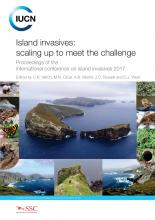
Island invasives : scaling up to meet the challenge.
Biodiversity Conservation, BRB
Available Online

Clout, M.N.

,

Martin, A.R.

,

Russell, J.C.

,

Veitch, C.R.

,

West, C.J.

2019
The papers in this volume were, with a few exceptions, presented at the third Island Invasives conference, held in Dundee, Scotland in July 2017. The papers demonstrate up-scaling in several aspects of eradication operations – not least in ambition, land area, operational size, global reach and of course financial cost. In the space of a few decades, the size of islands treated for invasive species has increased by five orders of magnitude – from a few hectares to over 100,000 ha or 1,000 km2. Meanwhile, the diversity of species being tackled has increased, as has the range of countries now actively carrying out island restoration work. Inspired by pioneers from New Zealand and Australia, principally, today the movement has spread to islands in all oceans and off all continents. This expansion has been informed by, and has in turn produced, growing experience in all aspects of this field, from non-target impacts to ecological responses to factors affecting eradication success. A major aim of publishing these Proceedings is to inform people who are, or will in the future be, planning new projects to free islands of invasive species. Regardless of its location or the target species involved, each successive operation builds on the experience of those who have gone before, and the papers in this volume represent an invaluable wealth of such experience.
A region at risk - The human dimensions of climate change in Asia and the Pacific
Climate Change Resilience, Biodiversity Conservation
Available Online

Asian Development Bank

2017
The Asia and Pacific region is extremely vulnerable to the impacts of climate change. Unabated warming could significantly undo previous achievements of economic development and improvements of living standards. At the same time, the region has both the economic capacity and weight of influence to change the present fossil-fuel based development pathway and curb global emissions. This report sheds light on the regional implications of the latest projections of changes in climate conditions over Asia and the Pacific. The assessment concludes that, even under the Paris consensus scenario in which global warming is limited to 1.5°C to 2°C above preindustrial levels, some of the land area, ecosystems, and socioeconomic sectors will be significantly affected by climate change impacts, to which policy makers and the investment community need to adapt to. However, under a Business-As-Usual (BAU) scenario, which will cause a global mean temperature rise of over 4°C by the end of this century, the possibilities for adaptation are drastically reduced. Among others, climate change impacts such as the deterioration of the Asian “water towers”, prolonged heat waves, coastal sea-level rise and changes in rainfall patterns could disrupt ecosystem services and lead to severe effects on livelihoods which in turn would affect human health, migration dynamics and the potential for conflicts. This assessment also underlines that, for many areas vital to the region’s economy, research on the effects of climate change is still lacking.