Search the SPREP Catalogue

Refine Search Results

Language

Available Online

Available Online

86 result(s) found.

Sort by

You searched for

  • Author Asian Development Bank
    X
A region at risk - The human dimensions of climate change in Asia and the Pacific
Climate Change Resilience, Biodiversity Conservation
Available Online

Asian Development Bank

2017
The Asia and Pacific region is extremely vulnerable to the impacts of climate change. Unabated warming could significantly undo previous achievements of economic development and improvements of living standards. At the same time, the region has both the economic capacity and weight of influence to change the present fossil-fuel based development pathway and curb global emissions. This report sheds light on the regional implications of the latest projections of changes in climate conditions over Asia and the Pacific. The assessment concludes that, even under the Paris consensus scenario in which global warming is limited to 1.5°C to 2°C above preindustrial levels, some of the land area, ecosystems, and socioeconomic sectors will be significantly affected by climate change impacts, to which policy makers and the investment community need to adapt to. However, under a Business-As-Usual (BAU) scenario, which will cause a global mean temperature rise of over 4°C by the end of this century, the possibilities for adaptation are drastically reduced. Among others, climate change impacts such as the deterioration of the Asian “water towers”, prolonged heat waves, coastal sea-level rise and changes in rainfall patterns could disrupt ecosystem services and lead to severe effects on livelihoods which in turn would affect human health, migration dynamics and the potential for conflicts. This assessment also underlines that, for many areas vital to the region’s economy, research on the effects of climate change is still lacking.
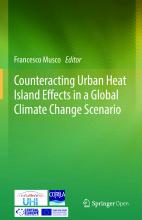
Counteracting Urban Heat Island Effects in a Global Climate Change Scenario
Available Online

Francesco Musco

2016
Reflect on the present, on the dynamics and the conditions that built it, and look forward at the same time, in search of a prospect to improve the future. Since Howard (1850–1928) and Geddes (1854–1932), this has been the dominant logic supporting the work of all those (architects, urban planners, planners, landscape architects, etc.) who grappled with city and territorial management and planning. However, from the 1970s, territorial planning has been confronted with new concepts – such as sustainable development, environmental sustainability and social equity – and more recently, new challenges – such as the ones linked to climate change, which led to the need to redefine territorial planning in disciplinary and operational terms. For some years now, the planner’s new role is under discussion, especially in relation to the challenges posed by climate change. Sustainability, mitigation, adaptation, renewable energy, low-carbon transition, ecosystem approach and post-disaster planning are just some of the new keywords surrounding the discussion on territorial management and planning. This chapter aims to present rationally, what it means to re-organize and re-think the city, in a long-term perspective. It wants to show how it is possible, and above all is a duty to integrate the new concepts mentioned above in urban planning, to deal with the effects of climate change. The Urban Heat Islands contrast enters fully into the feasible experimentation with appropriate innovations in territorial planning. The paper draws attention to the Italian situation, in the light of the European reference framework.