Search the SPREP Catalogue

Refine Search Results

Related Countries

Language

Available Online

Related Countries

Available Online

34 result(s) found.

Sort by

You searched for

Mainstreaming climate change in ADB's operations: climate change implementation plan for the Pacific Islands 2009-2015 Part 1: main report : Consultation draft; Part 2: Appendices, consultation draft
Climate Change Resilience, Biodiversity Conservation
Available Online

ADB

2009
This Climate Change Implementation Plan (CCIP) for the Pacific Regional Department (PARD) of the Asian Development Bank (ADB) describes the areas of focus for PARD's operations and identifies key gaps between country and ADB actions, as well as opportunities for scaling up ADB's assistance related to mitigation, adaptation and associated cross-cutting needs. This gap analysis points to recommended interventions in regional and country programs for additional technical assistance (TA) and financial assistance, including access to new climate funds and adoption of new financing mechanisms. These include multi-donor Climate Investment Funds (Clean Technology Fund and Strategic Climate Fund), ADB's Future Carbon Fund, and possibly a new Sustainable Fuel Credits mechanism to promote reduced petroleum consumption. The CCIP will evolve through periodic updates in order to effectively guide ongoing and future programs and TA and project design. Going forward, specific climate change interventions will continue to be incorporated into the Country Partnership Strategy (CPS) and Country Operations Business Plan (COBP) for each Pacific Developing Member Country (PDMC) and into the Regional Operations Business Plan (ROBP) for the Pacific region as a whole. TA and investment projects will be designed, taking into consideration regional and country variations in governance, institutional capacity, and geographic and local environmental conditions.
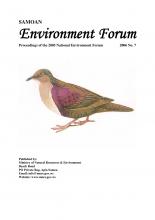
Samoan Environment Forum: proceedings of the 2005 National Environment Forum|The fact-or-myth of Samoan cultural heritage: personal reflections on family oral history / Tu'u'u Ieti Taule'alo|Samoan and Japan: concerns over mangroves development / Juliet Boon-Nanai|Status of hawksbill turtle nesting in Samoa, 2003/2004 / Mauigoa Lui Bell, Malama S. Momoemausu, Juney Ward & Malaki Iakopo|Participatory approaches for environmental initiatives - community consultation in Samoa / Natalie Mitchell|Emotional intelligence, management concept: a contributing factor for effective service delivery / Mulipola Ausetalia Titimaea|Tropical cyclone forecasting: theory and practical application - case study of tropical cyclone Olaf 2005 / Sala Sagato Tuiafiso|Samoa and the World Heritage Convention - is Samoa ready for world heritage listing / Tuiolo Schuster|Exploring the status of tsunami early warning systems in Samoa / Shaun P. Williams & Aliimalemanu F.M. Leavasa|Determination of a mean daily discharge values for Faleaseela River: implications for population water demand / Masina Nagau Chun, Iosefatu Eti & Mulipola A. Titimaea
Available Online

MNRE

2006
The community based conservation (CBC)paradigm predicts that sustainable biodiversity can only be achieved if local people perceive benefits from conservation. Through interviews, the situation in Samoa portrays that the CBC of mangroves was received with apprehension because the mangrove biodiversity was more significant than sustaining the livelihood of the local communities. In contrast, Iriomote Island residents were able to achieve maximum socio-economic benefits but to the extent that they were over commercializing the mangrove ecosystem. More research is imperative to find out how biodiversity conservation can be married with sustainable development objectives to sustain the local communities' livelihood.