Search the SPREP Catalogue

Refine Search Results

Tags / Keywords

Available Online

Tags / Keywords

Available Online

1087 result(s) found.

Sort by

You searched for

  • Collection BRB
    X
Impacts of aerial 1080 possum control operations on North Island robins and moreporks in Pureora 1997 and 1998
BRB
Available Online

Knegtmans, Jaap W.

,

Powlesland, Ralph G.

,

Styche, Andrew

1999
This is the final report describing the results from the second and third years of a three-year programme to determine the costs and benefits of aerial 1080 possum control operations to North Island robins (Petroica australis longipes) and moreporks (Ninox novaeseelandiae) in Pureora Forest Park, North Island, New Zealand. During this study robins were individually colour-banded, and moreporks radio-tagged in both treatment and non-treatment study areas. A poison operation using carrot baits in August 1997 covered 8577 ha and incorporated the 300 ha Waimanoa study area. A poison operation using cereal baits in August 1998 covered just the 200 ha Long Ridge study area. After the 1997 operation, very few possums remained alive and rat foot-print tracking indices remained very low during the robin nesting season (September 1997 February 1998). Similarly, possum and rat population indices were much reduced after the 1998 operation, but rats and possums were found in a small portion of the study area, presumably because it did not receive baits. Following both the 1997 and 1998 poison operations, there was no significant difference in the proportion of banded robins that disappeared from the non-treatment and treatment study areas. During the 1997/98 nesting season, the nesting success of robins was significantly better in the treatment area than in the non-treatment area. One year after the poison operation (spring 1998), the robin population in the treatment area had increased by 37% on the number present just prior to the poison operation, compared with 16.3% in the non-treatment area. No radio-tagged moreporks were available in the treatment area during the 1997 poison operation, and all three radio-tagged in each of treatment and non-treatment areas were still alive two months after the poison operation in 1998.
Funtional Roles of Invasive Non-indigenous Plants in Hurricane-Affected Subtropical Hardwood Forests

BRB
Available Online

Freedman, Andrea.

,

Hoffstetter, Ronald H.

,

Horvitz, Carol. C.

,

McMann, Stephen.

,

Pascarella, John B.

1998
Native forest species exhibit a well-known range of ecological roles with respect to natural disturbance regimes, from pioneer phase to mature phase, and they regenerate from a range of sources, including dormant seeds, seed rain, pre-established juveniles, and resprouts from damaged adults. In contrast, the ecological roles of invasive, non-indigenous species in forest communities after natural disturbances are not well understood. Some previous studies of invasive species have emphasized their weedy nature and their ability to colonize anthropogenic disturbances. Tropical hardwood hammock forest in southern Florida experience frequent disturbance by hurricanes. Our studies of forest regneration during two years following a recent severe hurricane suggest that invasive non-indigenous forest species exhibit the same range of ecological roles as native forest regeneration during two years following a recent severe hurricane suggest that invasive non-indigenous forest species exhibit the same range of ecological roles as native forest species and compete with native species for particular kinds of regeneration opportunities. To study ecological roles of non-indegenous species in regenerating forests after Hurricane Andrew, we set up four large study areas at each of three study sites that had differing amounts of hurricane-caused canopy disturbance. There were two pairs of 30 X 60 m research plots per site, and in each pair there was one control plot and one restoration plot; restoration areas were subject to an aggressive management program, focused on reducing non-indigenous vine cover. Within these study areas we subsampled vegetation in small study plots that were regularly spaced, and conducted vegetation censuses in April (the end of the dry season) and October (the end of the rainy season) for 2 yr, beginning in April 1993. We found that the source of regeneration for forest species was dependent upon the amount of canopy disturbance, the time since disturbance, and the autecology of the constituent species. Overall, 28% of the 90 species were non-indigenous: 34% of the vines (N=32) and 24% of other life-forms (N=58). Non-indigenous vines seemed to have a special role; not only could they compete with native vines, but they could also negatively affect the regeneration of other natives from a diverse array of sources including pre-established juveniles and resprouts from damaged adults. Both native and non-indigenous vine cover in unmanipulated study areas increased following the hurricane. Non-indigenous vine species had higher cover than native vine species, and many species formed dense "blankets." Non-indigenous species in general (not just vines) did not differ significantly from native species in seed mass, nor were they restricted to the pioneer type of life history. Many non-indigneous species had invaded forests prior to hurricane disturbance and had their own banks of pre-established juveniles; others recruited from dormant seeds, and seed rain, and/or respouts from pre-established adults. Based on information on source of regeneration and impact on native species, we propose a classification scheme for functional roles of non-indigenous invasive species in forests. To investigate whether non-indigenous taxa had roles in other geographic regions similar to those they had in Florida, we reviewed literature for 50 taxa belonging to genera that have species known to be invasive in southern Florida. We found that these taxa were invsive or had cogeners that were invsive in other geographic regions (Western Australis, the Mariana Islands, Hawaii, the rMascarene Islands, and South Africa). We propose that taxa predominantly retain their invasive, functional-role type across regions. Thus, studies of ecological roles of invasive species with respect to natural disturbance regimes in one region may help us predict invasive roles in other regions.
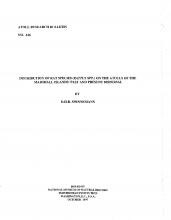
Distribution, relative abundance, and habitat relationships of landbirds in the Vava'u group, Kingdom of Tonga / by David W. Steadman and Freifield, Holly B.
BRB
Available Online

Freifield, Holly B.

,

Steadman, David W.

1998
We assessed the distribution, relative abundance, and habitat preferences of the 12 indigenous, resident species of landbirds that survive in the Vava‘u Group, Kingdom of Tonga. We surveyed 16 islands, 10 of which are previously unmentioned in ornithological literature. The islands vary in land area (0.02-96 kn?), habitat composition, elevation (20- 215 m), and distance (O-lo.1 km) from the largest island of ‘Uta Vavdu. We conducted point counts along transects on 14 of the islands, and placed each count location into one of five habitat categories. Of the 11 species of landbirds that are widespread and at least locally common, 7 (Purple-capped Fruit-Dove Ptilinopus porphyraceus, Pacific Pigeon Ducula pacijca, Common Barn-Owl Tyto alba, White-rumped Swiftlet Collocalia spodiopygia, Collared Kingfisher Halcyon chloris, Polynesian Tiiller Lalage maculosa, Polynesian Starling Aplonis tabuensis) certainly or probably occur on each of the 16 islands. One species (West Polynesian Ground-Dove Gallicolumba stairii) is extremely rare (one small population on one island). Three species that we did not record (Many-colored Fruit-Dove Ptilinopus perousii, Blue-crowned Lorikeet Vini australis, Fiji Shrikebill Clytorhynchus vitiensis) probably have been extirpated from Vava‘u. The species richness and relative abundance of landbirds on islands in Vava‘u are affected more by deforestation and other human activities than by island area, elevation, or isolation.
Environmental effects of rodent Talon baiting Part I : Monitoring for toxic residues : Part II Impacts on invertebrate populations
BRB
Available Online

Morgan, D. R.

,

Spurr, E. B.

,

Wright, G. R.

1998
Although Talon® baits containing brodifacoum have been used successfully in eradicating rats from some of New Zealand’s offshore islands, little is known about any environmental effects of this toxin. We sampled invertebrates, blackbirds, soil, and water at intervals of 2 days to 9 months to determine whether brodifacoum residues were present after aerial distribution of Talon® 20P cereal pellets on Red Mercury Island and after bait-station use of Talon® 50WB wax-coated cereal blocks on Coppermine Island. No brodifacoum residues were found in soil, water, or most (99%) invertebrate samples. Low to moderate residues were found in one sample of slugs collected 2 days after aerial sowing. Tissues from all birds (n=4) and rats (n=3) found dead and livers from all six birds collected alive 8 months after aerial baiting also contained low to moderate residues. These preliminary results suggest that few invertebrates are likely to be contaminated as a result of Talon® baiting. Tentatively, we suggest that although some invertebrates may eat Talon® baits, it appears that the brodifacoum is either metabolised and/or excreted within a few days. The dead blackbirds found, therefore, were more likely to have been killed by primary than by secondary poisoning. Further monitoring for brodifacoum residues after Talon® operations should be undertaken to confirm that contamination of invertebrates, soil, and water is unlikely. Some bird species may be at risk from Talon® baiting. Likely effects on population levels of such species should be considered to help assess the risk and benefits of Talon® use in rodent eradication.