Search the SPREP Catalogue

Refine Search Results

Tags / Keywords

Available Online

Tags / Keywords

Available Online

1087 result(s) found.

Sort by

You searched for

  • Collection BRB
    X
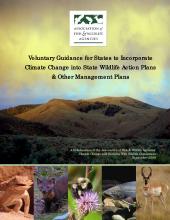
Voluntary guidance for states to incorporate Climate Change into State Wildlife Action Plans & Other Management Plans
Climate Change Resilience, BRB
Available Online

Association of Fish & Wildlife Agencies

,

Climate Change Wildlife Action Plan Work Group

2008
The Climate Change Wildlife Action Plan Guidance Document provides voluntary guidance for state fish and wildlife agencies wanting to better incorporate the impacts of climate change on wildlife and their habitats into Wildlife Action Plans. The approaches and techniques described in this document also will be useful in modifying other wildlife plans (e.g. big game/upland game/migratory bird plans, joint venture implementation plans, national fish habitat action plan, etc.) to address climate change. The document provides an overview of the information currently available on climate change, tools that can be used to plan for and implement climate change adaptation, voluntary guidance and case studies. Climate change is a large and growing threat to all wildlife and natural systems and will also exacerbate many existing threats. Efforts to address climate change should not diminish the immediate need to deal with threats that may be independent of climate change such as habitat loss/fragmentation from development, introduction of invasive species, water pollution and wildlife diseases. Since climate change is a complex and often politically-charged issue, it’s understood that the decision to revise Wildlife Action Plans or other plans to address climate change, rests solely with each state fish and wildlife agency.
Conservation of kakerori (Pomarea dimidiata) in the Cook Islands in 2006/07
BRB
Available Online

Robertson Hugh a.

,

Saul. Edward K.

2008
In 1989, the kakerori (Pomarea dimidiata) was one of the 10 rarest birds in the world with a declining population of just 29 individuals living in forested hill country in the Takitumu Conservation Area (TCA) of south-eastern Rarotonga, Cook Islands. Following 12 years of rat poisoning, the population had increased to 255 birds in August 2001. The programme then shifted from ‘species recovery’ to ‘sustainable management’ of the Rarotonga population at 250 to 300 birds. The rat poisoning effort was reduced, and an ‘insurance’ population was established on Atiu. By August 2004, following the reduction of poisoning from weekly to fortnightly, and the transfer of 30 youngsters to Atiu in 2001–03, there were 281 birds on Rarotonga and 25 on Atiu. The southern Cook Islands were hit by five tropical cyclones in a four-week period in February–March 2005, and forests on Rarotonga were severely damaged. Kakerori survived the storms remarkably well, but the main effect was observed in the following breeding season (2005/06), when nesting success on Rarotonga was exceptionally poor. Reduced canopy cover caused nests to be exposed to abnormally wet conditions, and lack of fruit meant that rats were exceptionally hungry. Only 31 yearlings were known to be alive in August 2006—about half the expected number—and annual mortality of banded birds (25%) was the highest since management began. The kakerori population on Rarotonga fell 8% from 275 birds in August 2005 to a minimum of 254 birds in August 2006. The situation was better on Atiu, with the population growing from about 32 adult birds in 2005/06 to a minimum of 37 adult birds in 2006/07, and an Atiu-bred pair nested successfully for the first time. The 2006/07 breeding season on Rarotonga was moderately successful, with a minimum of 51 fledglings found. Because the ‘sustainable management’ regime of fortnightly rat poisoning in the TCA was only just adequate in giving protection to adult kakerori, the annual poisoning programme was modified by adding rounds of ‘interim’ poisoning in April and July 2007 aimed at reducing rat and cat numbers before the breeding season.
Biology and impacts of Pacific Island Invasive species 4. Verbesina encelioides, Golden Crownbeard (Magnoliopsida: Asteraceae)
Biodiversity Conservation, BRB
Available Online

Clements, David R.

,

Feenstra, Kathleen R.

2008
Verbesina encelioides (Cav.) Benth. & Hook. f. ex A. Gray, golden crownbeard, is a sunflower-like herbaceous annual plant ranging in height from 0.3 to 1.7 m with showy yellow flowers. It is native to the southwestern United States, the Mexican Plateau, and other parts of tropical America. Its invasive characteristics include high seed production (as many as 300-350 seeds per flower and multiple flowers per plant), seed dormancy, ability to tolerate dry conditions, and possible allelopathic effects. Disturbed areas with a relatively sandy substrate within warm, arid climate zones are vulnerable to invasion by V. encelioides. Veresina encelioides is found on all of the main Hawaiian islands except Ni'ihau but is particularly problematic on Midway and Kure Atoll, where it may threaten the habitat of nesting birds such as Laysan and black-footed albatrosses and Christmas and wedge-tailed shearwaters. Many other Pacific islands with similar habitats could be invaded by the V. encelioides. The plant has become naturalised in many other U.S. states, parts of South America, the Bahamas, Cuba, the Dominican Republic Puerto Rico, parts of Europe, Saudi Arabia, India, Ethiopia, Morocco, Botswana, Namibia, Israel, and Australia. It is a pest of various crops in the southern United States and India and is poisonous to sheep and cattle. Verbesina encelioides can be controlled via herbicides or mechanical means, but measures must be repeated due to the presence of persistent seed banks. Further research on V. encelioides is needed to understand its population dynamics, allelopathic properties, and impacts on natural ecosystems.